
For Keeps

Bookstore vs. Museum Brain
I work at a used bookstore in Pasadena. Customers frequently remark on how “old school” the shop is. It is, in fact, an antidote to the trend among LA bookstores—tiny storefronts selling 100 beautiful objects, immaculately curated, with a pricepoint to match. My bookstore is a vortex of unsorted piles where chaos reigns and everything is for sale. Captain Underpants exists on an even plain with a leatherbound first of Cannery Row. Bataille’s “Accursed Share” is shelved next to Napoleon Hill’s “Think and Grow Rich.” Entropy is order.
My inner art snob winces watching customers flip through fragile tomes of Shakespeare from the 1800s with Boba Tea in hand. But bookstores are museums where one needn’t don gloves to handle the treasures.
The best way to destroy a book is to read it. This is the nature of decay that museums and white cube galleries try to suspend.
Stuff Found in Books
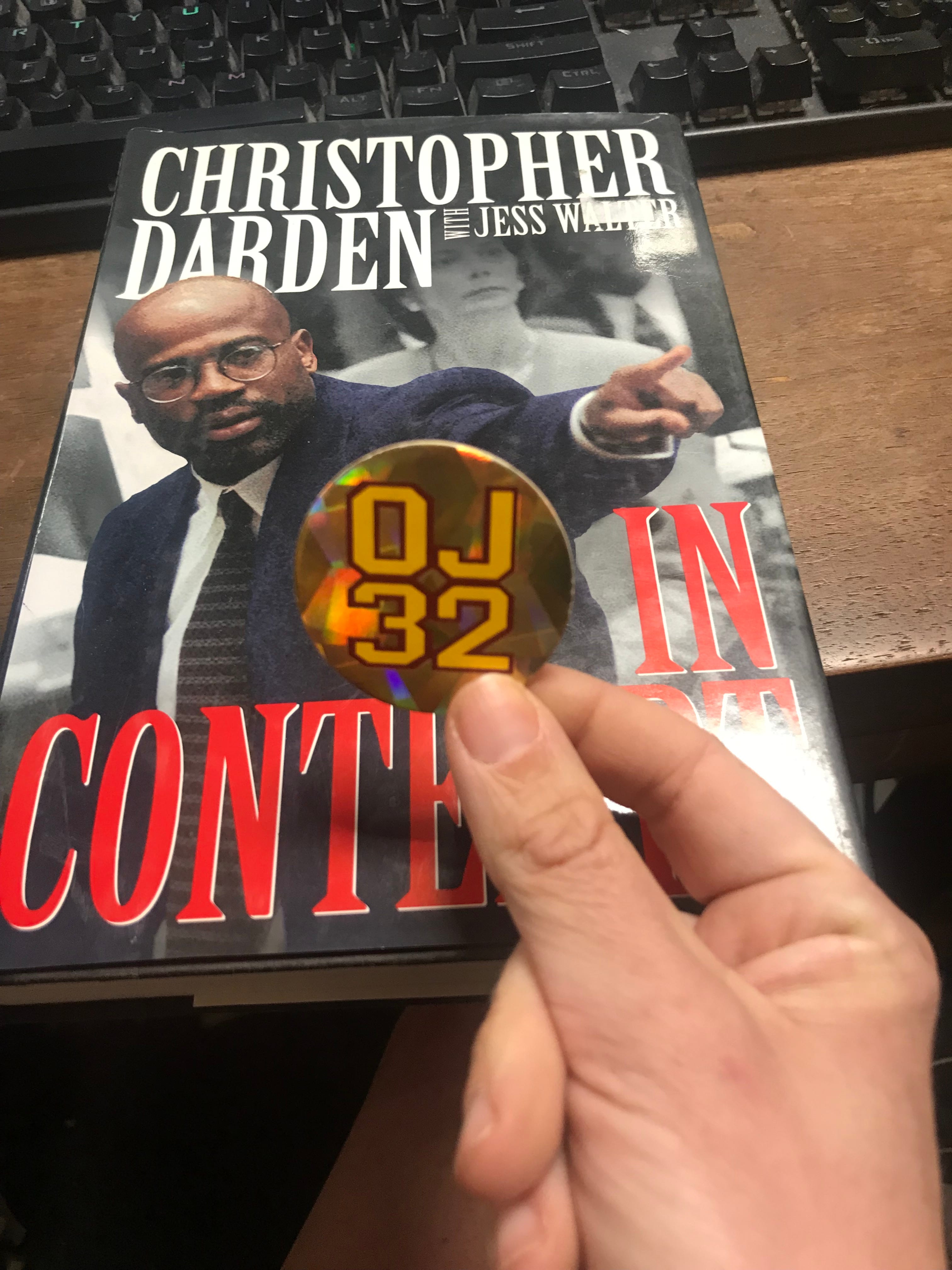
My first day of condition grading at Book Alley I found an OJ Simpson POG inside a hardcover Christopher Darden memoir. My colleagues calmly suggested this be placed in the Ephemera Drawer where we affixed it with a $5 price tag. There are lots of things found in books other than its author’s ideas. Photographs, receipts, boarding passes, romantic notes, perfunctory notes, NEVER MONEY, but biohazards, to be sure. A paperback of Hemingway’s Moveable Feast came splattered with carrot barf. Euphemisms like “bio-predation” are created for these encounters.
One of the most common discoveries is marginal writing from previous owners. I frequently process collections filled with notations—evidence of the books’ past lives. There’s a cumulative intimacy in handling a stranger’s possessions and seeing their marks across multiple texts. The experience can feel like a parasocial mediumship: indirect connection with a stranger, with a spiritual dimension. They held what I held in their hands, in their homes, and now their notes are invading my brain.
Guerrero
Guerrero Gallery is in my neighborhood, therefore I have perfect attendance at their art shows. But the high caliber of their exhibits transcends convenience. In 2024 they extended their exhibition space into a carriage house, across a small courtyard. The carriage house has the ambiance of an Air BnB—polished floors, ample countertops and stainless steel appliances. For Keeps Books and Rosie Lee Tompkins’s archival objects offset the sunny blandness.
For Keeps
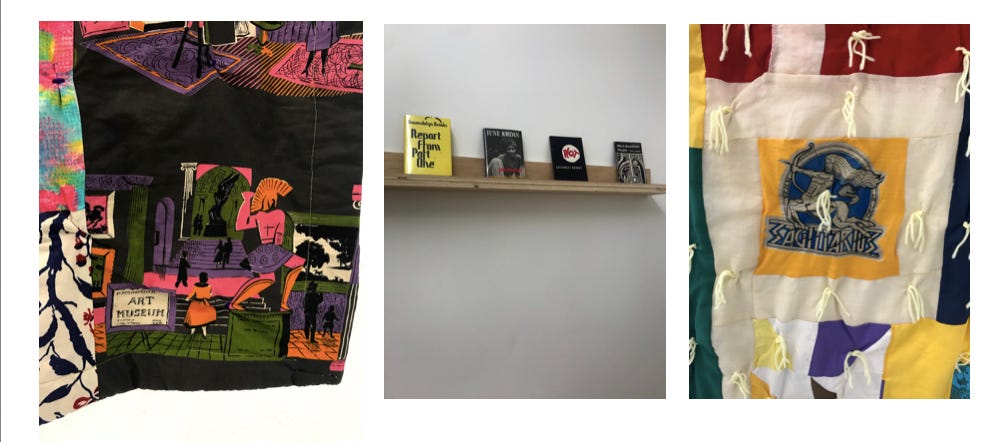
For Keeps operates a physical storefront in Atlanta GA, unabashedly foregrounding collectible vintage books by Black authors. The selection displayed at Guerrero centered Black women: June Jordan, Gwendolyn Brooks, Audre Lorde’s “Uses of the Erotic,” early chapbooks by Sonia Sanchez & an Adrian Piper monograph staged along a ledge. Staplebound pamphlets covered a pedestal which viewers were authorized to touch. In past work as a gallery attendant I was obligated to ask guests to step away from artworks. Here I floated around the gallery unmonitored, handling the goods, absorbing the aura—the radical frisson just rolling off the pamphlets.
Rosie Lee Tompkins
Guerrero Gallery’s roots are in the Bay, the home of the visionary quilter Rosie Lee Tompkins from the 1950s til her death in 2006. Through a partnership with the artist’s estate, they have shown her pieces in multiple contexts. My first encounter was with a deliciously asymmetrical appliqué quilt embellished with glittery vintage iron-ons and evenly metered yarn tassels. One quilt back was patched with midcentury novelty fabric depicting visitors at a museum, marveling at landscape paintings and giant sculptures. This felt prescient on the part of the artist whose textiles entered the public eye through shows at the Richmond, CA Art Center before being collected by quilt scholar Eli Leon and exhibited at museums from Berkeley to the 2002 Whitney Biennial and beyond.
Stuff Found in Beds:
Fuzz, stray hairs, dryer sheets, dryer lint, a stray staticky sock, coffee stains, drool stains, cum stains, condoms, period stains, an ipad, some ear pods, cat hair, cat barf, a cat (if you’re lucky), skin flecks, a ziggurat of pillows, an appliqued list of everyone I’ve ever slept with, my boyfriend (often), my own reclining human form…
Aura is the energetic force that flows around an object.. A Brancusi bronze has an aura, but is so many steps away from the artist’s touch by virtue of its reproduction.
Tompkins’ quilts bring me pleasure through their adherence to traditional patterns and their deviations from standard forms–they are bold and vivid undulating grids, peppered with surprises — and their proximity to the artist’s hand. I’m seduced by their tactility.
You can’t snuggle a Brancusi (but I invite you to try).
Quilts are records of time, archives themselves, indexes of fabrics in varying shapes and tones, offering endless combinations but anchored in their singular specialness. In an era of unbounded digital mediation I felt grounded and lifted by its implications: intergenerational collaboration, “matrilineal witnessing” (per Dian Millian), and an altered protocol from conventional art viewing behavior.
Sources:
https://www.artpapers.org/heritage-algorithms/
https://www.nytimes.com/interactive/2020/06/26/arts/design/rosie-lee-tompkins-quilts.html