
Docent Jewelry
On Wacky Pomo, cow humor, and ladies of a certain age

I just finished designing a logo for an experimental theater festival. The logo’s style was guided by the principles of a freshly minted aesthetic:
I’m calling it “Cow Tools via Memphis Milano.”

It’s inspired by a theatrical piece of neckwear obtained at the best estate sale I’ve ever been to in my life. A Nickelodeon executive’s belongings were being liquidated from her Studio City home. It was evident in every inch of her house that this woman presided over Nickelodeon during its early 90’s reinvention— the Nicktoons years— when Doug, Rugrats, Ren & Stimpy and Rocko’s Modern Life revamped the channel, sprawling across its primetime schedule. Crude, bold color echoed the crude, bold content; undulating palm trees across woozy geometric fields, small s surrealism, visual motifs cribbed from the designs of Nathalie Du Pasquier and Ettore Sottsass, in a style retroactively crowned as WACKY POMO. It was the channel’s first original programming, and its feet were planted in an established point of view.
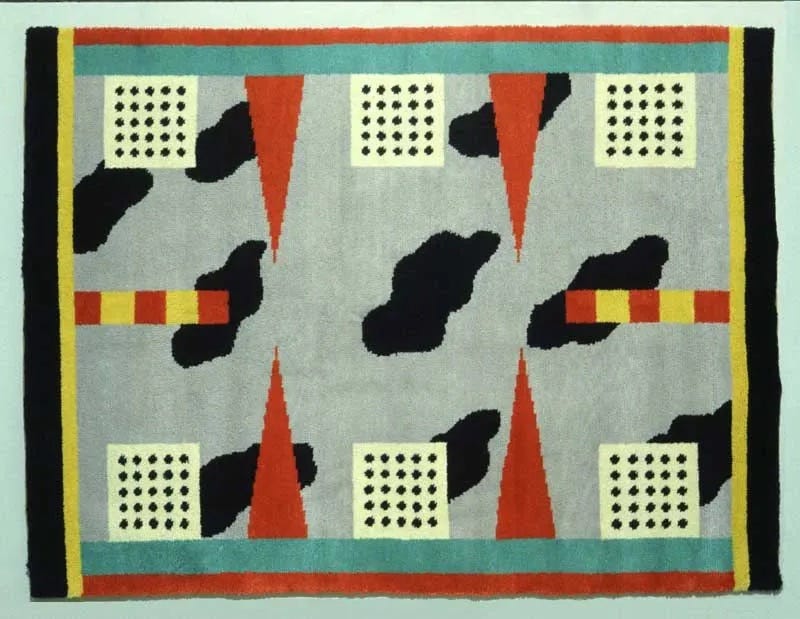
Wacky Pomo
Ms. Nicktoons’ estate was populated by authentically wacky Postmodern furniture —concrete and rubber end tables, vintage formica and plexiglass bed frames, gaudy couches with bowling balls for legs, and an undeniable cow motif…but more on that later.
She had garments for every step and repeat on the slime green carpet which the estate sale jocks hungrily stockpiled—cunty holographic handbags with mathy little clasps, Custo prints, Missoni knits and Issey Miyake pleats— but I was there for books…until I laid my eyes on her marvelous collection of docent jewelry.
What is Docent Jewelry?
Docent Jewelry describes statement neckpieces, associated with ladies of a certain age— the ones who volunteer in museums. They may feature painted wood, shaped metal, coins or shells and feel vaguely ethnographic, skewing toward the culturally appropriative. The term can encompass scarves, shawls, glasses and glasses chains. You may see Docent Jewelry for sale at your art museum’s gift shop.
When I worked at the Neon Museum in Las Vegas an elderly woman called Bev who wore a re-creation of Liberace’s rings spent two hours every Thursday clogging patron access to the legendary Stardust sign. In her sequined piano print vest and silk ball cap, she’d splay her hands in front of her like fans, tiny rhinestone grand pianos glinting, and demand guests tell her “how they liked her jewelry ??” Other institutions where I’ve worked have boasted similar archetypes, but none so endearingly self-involved.
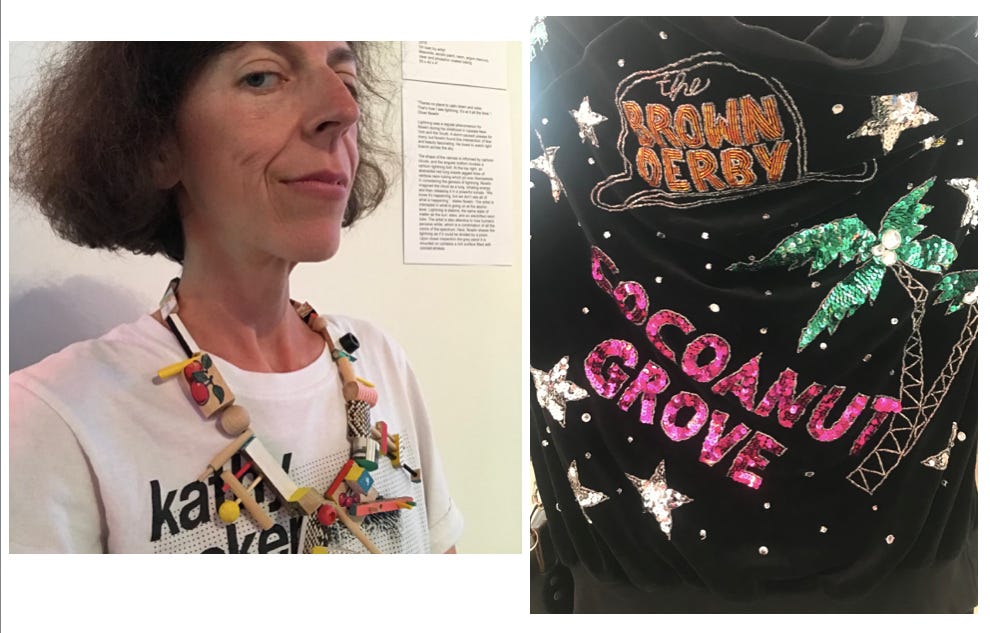
Weezy’s Neckwear
Louise Nevelson pioneered docent jewelry science, presaging the concept of social distancing by wearing small, cumbersome sculptures around her neck—collars made from protruding pieces of wood culled from the scrap piles of her rhythmic assemblages. Paired with giant tarantula lashes and a nude lip, she is a patron saint. I like to believe that she left them on while making love.
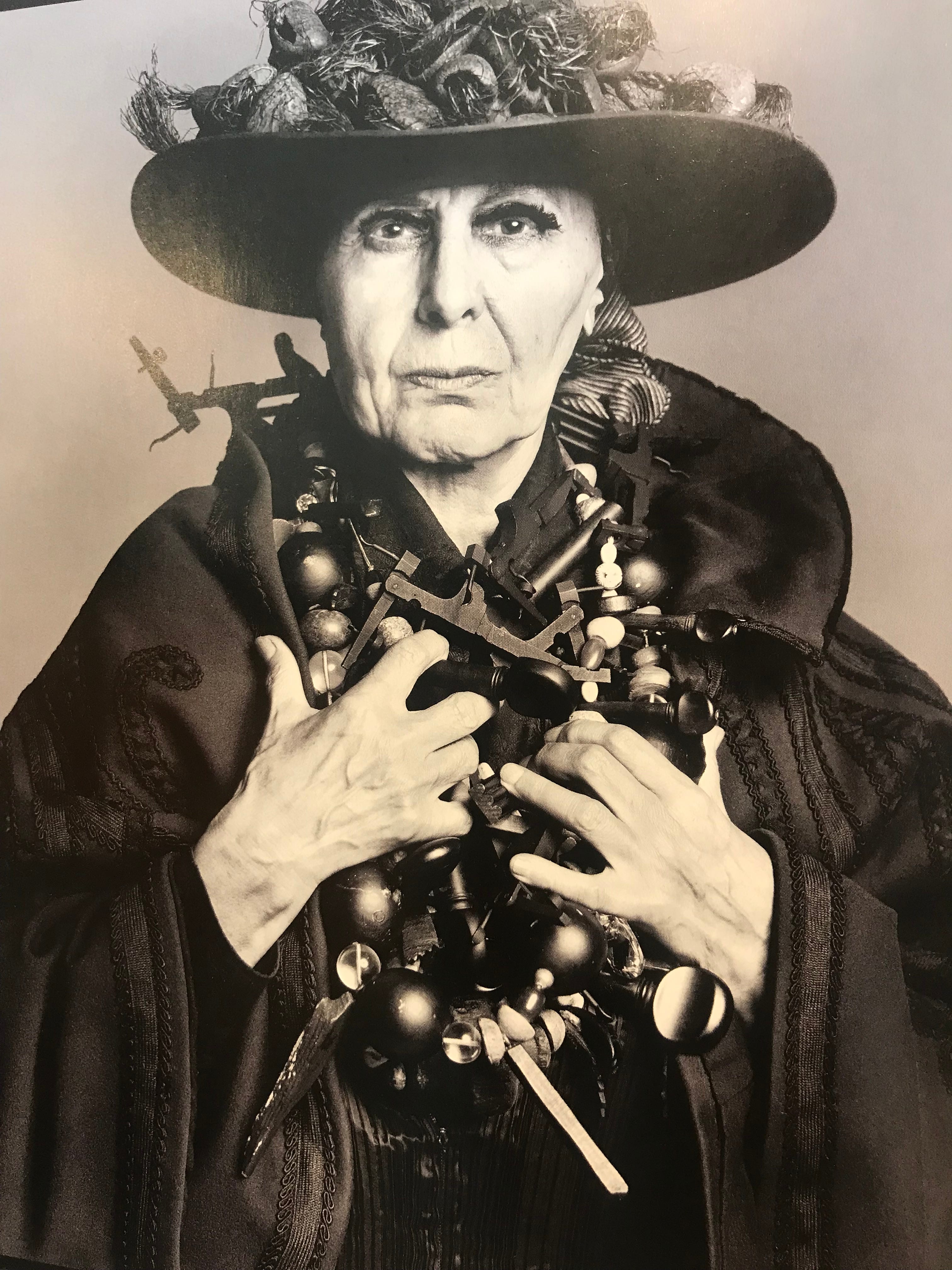
Nevelson’s necklaces could find kinship in “Cow Tools.”
Cows
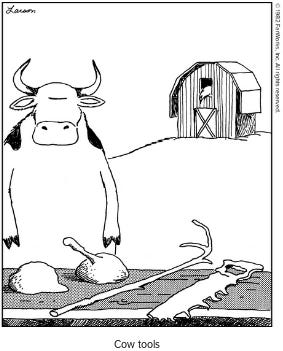
In the 1990s cows were comedy, and The Far Side was central in this conceit. Cows populated Gary Larson’s single panel comics: cows driving cars, bearing torches, smoking cigarettes and plotting in small conspiratorial herds. “Cow Tools” may be the magnum opus.
Shape empress & goth minimalist Mary Sabo describes the comic’s appeal:
“I think it was one of my first encounters with surrealism. And the shapes themselves are just fantastic. Like you can’t even imagine what they would be used for.”
While The Far Side is largely to blame, there are other cultural touchstones. Mad Cow Disease unwittingly brought cows into the public imaginary. Lore about aliens abducting and mutilating cattle proliferated. Bart Simpson urged us not to have a cow. Dead Milkmen’s “Surfin Cow” championed the concept of an aquatic bovine. As a child I used my own money (at Mr. Bulky in the Castleton Mall) to purchase a coffee mug depicting a cow in a nun’s wimple, frolicking on a a hill. It bore the text “The hills are alive with the sound of moosic.” This was par for the course.
This brings us back to Ms. Nicktoons’ estate. Alongside the deaccessioned diner furniture were sculptures of cows sponge painted in primary tones, following Jasper Johns lines. Her kitchen boasted cow print flatware, a kooky fake cow head and a variety of rubber figurines, cows central among them.
I’d trade all my books on Memphis to be a guest at one of her dinner parties, quaff a slime green cocktail and have her docent me through her house and its myriad collections: namely her secret bookcase full of animal liberation, direct action and sabotage texts (Ms. Nicktoons was an under radar comrade!), hear her pontificate on programmatic architecture. Most of all I’d wanna know about the cows.
Who made the life size alabaster cow, rearing on its hind legs, its giant white udder exposed to the world?
As a cultural impresario, is she an architect of Cows as Comedy?
Unfortunately, I will never be a recipient of her gentle guidance. Luckily, the job of tour guide chose me, and I take it as my life’s work to lead you, gentle reader, through this confluence of concepts, to illuminate the aesthetic undergirdings, swinging like an obscene cartoon.
Sources:
https://cari.institute/aesthetics/wacky-pomo
https://www.theringer.com/2021/08/12/tv/nickelodeon-nicktoons-animation-style-history